
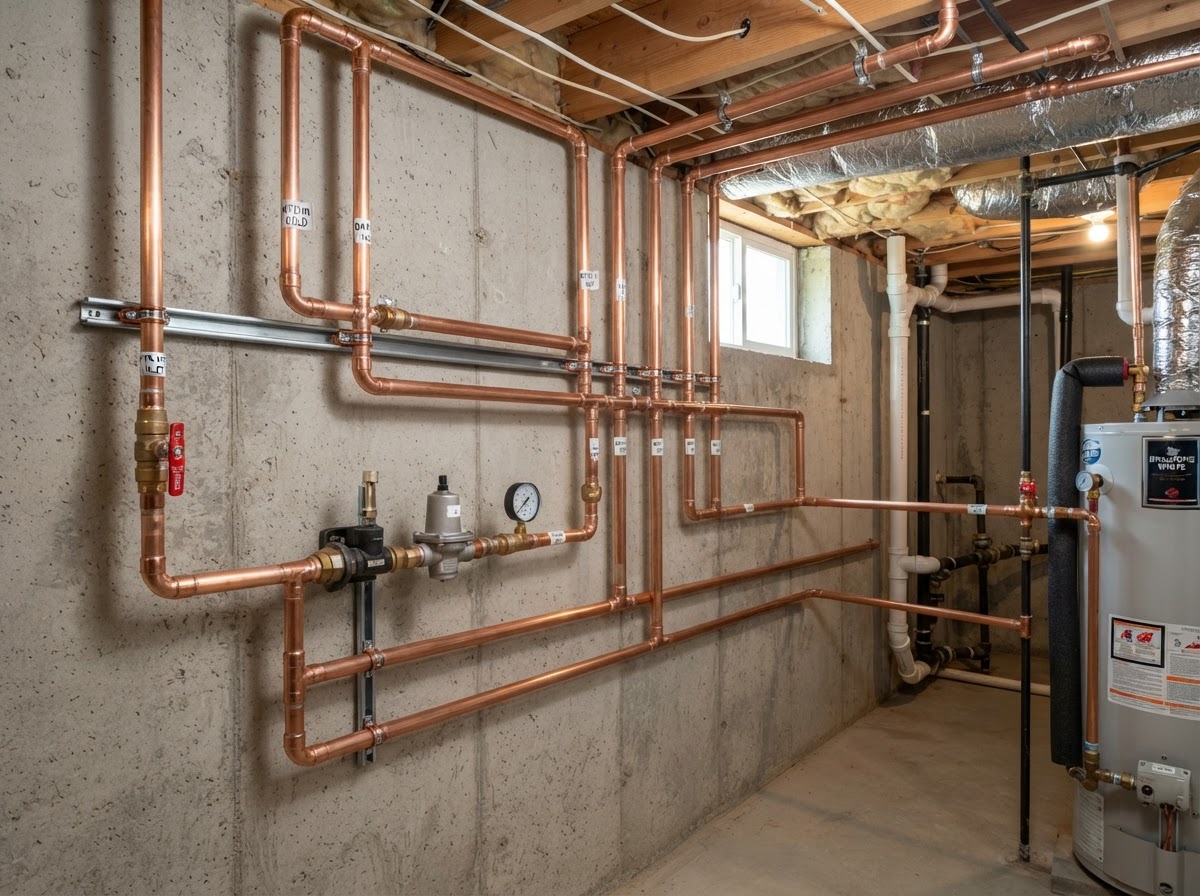
Weak water delivery is a symptom, not a diagnosis. A home inspection can observe accessible supply piping, visible leaks and fixture operation, but one running faucet cannot establish the condition of the entire system. Buyers should distinguish pressure from flow, identify whether the problem is local or widespread, and request the records or professional testing needed to explain it. Incoming service pipes and interior supply pipes also require separate material questions.
Pressure and flow describe different things
Pressure is the force available to move water through the system. Flow is the amount delivered over time. People often say “low pressure” when they mean that little water comes out of a fixture. That observation is useful, but it does not identify the cause. A restricted fixture, obstructed piping, a supply-control problem or a condition affecting the incoming service can produce different patterns. A plumber may need measurements at appropriate points and under defined operating conditions to distinguish them. A general inspection is not a complete hydraulic analysis of the building. When speaking with the inspector, describe the observation: which fixtures were operating, whether hot and cold behaved differently, and whether delivery changed when another fixture opened. Avoid replacing that description with an unsupported conclusion such as “the street pressure is bad.” The description preserves the information needed for a useful follow-up.
Begin with the pattern across the house
The Suffolk County Water Authority's low-pressure guidance distinguishes a problem at one fixture from broader supply concerns. It also notes that seasonal demand can affect conditions in its service area. Those are useful starting questions, not a diagnosis of a particular home or guidance for every Long Island water provider. Ask whether the concern appears at one outlet, several outlets, one floor or the whole building. Does it affect only hot water, only cold water or both? Was it observed once or repeatedly? The seller's account may help establish a pattern, but it should be identified as reported history rather than an inspection measurement. If municipal supply is involved, identify the actual provider for the address. Long Island has multiple water-supply arrangements. Do not assume an SCWA map or customer-service procedure applies to a Nassau County property or a home served by another district.
Accessible materials tell part of the story
Interior piping may include several materials installed at different times. An inspector can describe accessible visible sections and concerns such as leakage, deterioration, questionable connections or inadequate support. Finished walls and ceilings can conceal transitions and older runs. A new-looking manifold or exposed basement piping does not prove that all concealed distribution piping was replaced. Ask the seller to distinguish a complete repipe from replacement of selected sections. A contractor's invoice and photographs may clarify the work, particularly when the finishes hide most of it. Material identification should be specific to the portion observed. A photograph of one pipe near a water heater should not become a claim about every pipe in the house. Coatings, limited access and unfamiliar products can prevent confident identification. A useful report records that uncertainty and recommends the appropriate confirmation when it matters. The New York home-inspection standards address readily accessible supply and distribution components and functional observations. They do not turn a visual inspection into a determination of every concealed material or the water's chemical quality.
Keep the service line separate from interior plumbing
The service line brings water from the supply connection toward the building. Responsibility and records can differ along that route. The pipe entering the building may not establish the material for the entire buried line, and a utility record may distinguish utility-side and customer-side sections. SCWA's lead and copper information provides access to service-line information for its customers and explains its inventory context. Use the address-specific record where applicable and ask the provider what each designation means. “Unknown” is an information gap; it should not be silently converted into a confirmed material. If records are unclear, ask the utility and a qualified plumber about appropriate verification. Do not scrape, cut or disturb unfamiliar piping yourself. A water-quality question may require a properly selected sample and laboratory analysis, while a material-identification question may require different evidence. Neither should be answered solely from the strength of a faucet stream.
A symptom-to-follow-up guide
Use this table to route a question, not to diagnose or prescribe a repair. Several rows may apply at once. A house can have a local fixture restriction and a separate supply issue. The best follow-up tests the relevant possibilities instead of treating the first plausible explanation as proven.
Visible leakage needs location-specific documentation
A small drip, staining or deposits can warrant attention even when water delivery seems satisfactory. Ask whether moisture was active during the inspection and what could be seen around it. A dry stain records a condition worth explaining; it does not automatically prove an active leak or a completed repair. The follow-up should identify the affected component and any surrounding material that needs evaluation. A plumber can address the supply component; other professionals may be needed if concealed building materials are involved. Keep those scopes distinct so that replacing a pipe is not mistaken for confirming every adjacent condition. Do not operate old shutoffs or concealed valves to investigate a purchase yourself. Access, authorization and the condition of the equipment matter. If the inspector cannot safely operate a component, ask how that limitation affects the next step.
One observation is a snapshot of operating conditions
A fixture checked during a quiet midday appointment may not reproduce every household-use pattern. Conversely, weak delivery during unusually high demand does not establish that the whole system requires replacement. Record the actual observation and ask whether targeted measurements are needed. Discuss your intended use with a plumber if it differs materially from the current household's use. Multiple simultaneous showers or a renovation adding fixtures can create a design question beyond the normal inspection. That is separate from determining whether a visible component currently leaks. Illustrative scenario: a buyer sees strong flow at the kitchen faucet, but the upstairs shower weakens when another fixture operates. The kitchen observation remains valid. It simply does not answer the combined-demand question. A plumber's evaluation should reproduce relevant conditions and identify the cause before anyone selects a repair.
Request a useful plumbing history
Ask for documents that identify what was changed, where and when. “Updated plumbing” is too broad. A good record names the contractor, scope, materials, locations and any approvals relevant to that work. Keep water-heater changes separate from replacement of distribution piping or the incoming service. For a buyer inspection with STS, arrange access to visible piping, utility areas and fixtures. Review the service scope and explain known concerns before the appointment. The inspection can then distinguish observed conditions from reported history and inaccessible areas. Supply piping is only one part of the property's plumbing. Waste-pipe camera inspection and private-well performance have different questions and methods. If those are relevant, request the separately appropriate evaluations rather than expecting this supply review to answer them.