
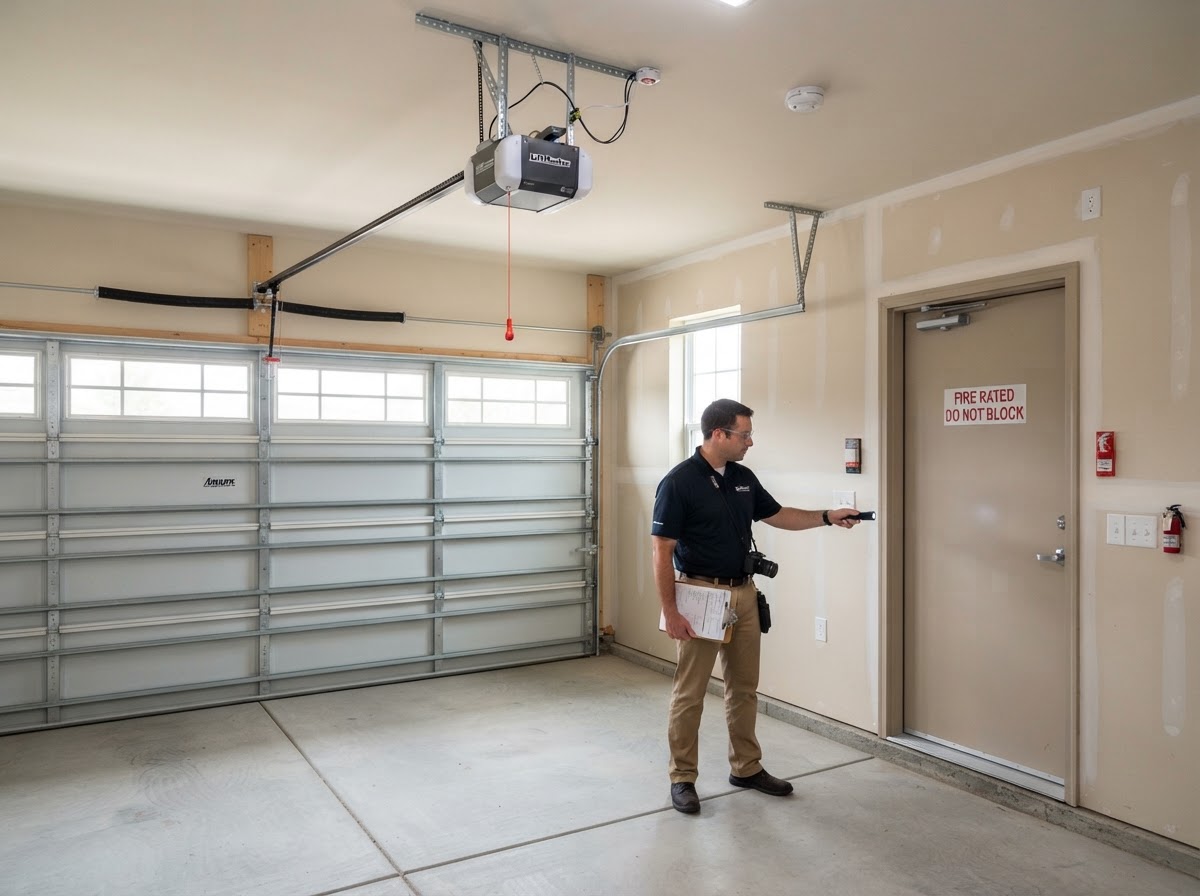
An attached garage deserves more than a quick look at whether a car fits. Buyers should ask about the accessible separation from living space, doors and penetrations, overhead-door operation, and conditions hidden by storage. A general inspection can identify visible concerns, but it cannot verify every concealed assembly or certify a garage as fireproof. Good access is often the most useful preparation a seller can provide.
Use the right term for the separation
The walls, ceilings, doors and penetrations between an attached garage and the dwelling form an important separation. Calling every such assembly a “firewall” is imprecise. A fire-resistance-rated assembly has a defined construction and performance basis; a visual home inspection does not establish a rating simply by seeing finished drywall. Ask what the inspector could observe: missing or damaged surfaces, openings, visible penetrations and the door between the garage and dwelling. Concealed framing, layers and connections may prevent a complete determination of construction. An older assembly also needs to be considered in the context of applicable requirements and any alterations, rather than judged solely against a generic online diagram. If a compliance determination is needed, the relevant building authority and qualified professionals should identify the applicable requirements. A home inspector's finding can prompt that inquiry without acting as a municipal approval or enforcement decision.
Air pathways are another reason the boundary matters
Gaps can connect garage air with the dwelling. The Pacific Northwest National Laboratory's attached-garage guidance explains the importance of controlling air movement through this boundary, including concealed pathways at framing and penetrations. That makes visible openings more than a cosmetic issue. Ask the inspector to identify their location and whether a qualified contractor should evaluate the separation. Do not fill an unfamiliar opening with an arbitrary product: the appropriate material and installation depend on the assembly and the purpose of the opening. Vehicle exhaust is a separate operating concern. Do not use an inspection appointment to run a vehicle or engine-powered equipment in the garage. A general inspection does not measure every possible pollutant exposure or demonstrate that opening the overhead door makes engine operation acceptable. Questions about equipment use should follow the relevant manufacturer's safety instructions and authoritative safety guidance.
The door to the house is not the overhead door
Keep these two components separate in the report. The pedestrian door between the garage and dwelling forms part of the boundary. Its visible condition, fit, operation and hardware can raise questions distinct from the large vehicle door. A replacement interior-style door, damaged panel, improvised opening or other alteration warrants evaluation in the applicable context. The correct construction and operating features depend on the requirements governing the property and installation. Avoid declaring one visible door compliant without confirming the relevant evidence. Ask whether storage prevented the door from closing or limited access to either side. A door that cannot be observed in normal operation leaves an inspection limitation, even if the seller says it works. Clear, authorized access is more useful than an assurance that an unseen component is satisfactory.
Overhead doors combine heavy moving parts and controls
An overhead garage door includes the door sections, tracks, supports, springs, cables, hardware and, where installed, an automatic opener. A normal-control observation is different from servicing or dismantling those parts. The Consumer Product Safety Commission's garage-door safety guidance highlights entrapment concerns and the importance of proper operation and professional attention to problematic doors. Buyers should not adjust springs, release unfamiliar mechanisms, defeat sensors or stand in the door's travel path to conduct their own test. STS's buyer-inspection description includes accessible garage observations and normal operation where appropriate. Confirm what the agreement provides, what safety features can be evaluated and whether any condition prevents operation. A visibly damaged or binding door may need a qualified garage-door professional before further testing.
A working opener does not resolve every door question
An opener can move a door while other concerns remain. Ask whether accessible hardware, supports, tracks and visible safety-related components were observed, and whether the report identifies any limitations. Do not interpret a single open-and-close cycle as a comprehensive service inspection. Remote controls, keypad programming and connected-app ownership are handover questions too. Request manuals and available controls, but avoid confusing those conveniences with mechanical condition. An opener's installation date also does not establish the age of the door or springs. If a repair is agreed, obtain a description that identifies the actual component and work performed. “Garage door repaired” may be too broad to compare against a finding about a particular support, control or operating problem. A service report can explain what was adjusted, replaced or left unresolved.
Prepare access before the appointment
Storage can conceal walls, floor edges, utilities and door components. The inspector generally will not move a garage full of belongings. Ask the seller to arrange access in advance without exposing anyone to unstable stacks or unfamiliar equipment. Access preparation does not require a buyer to relocate heavy property or operate equipment. If adequate access cannot be arranged, document the limitation and discuss whether a later visit or specialist appointment is needed.
Alterations can change the inspection question
A garage may have a finished room above it, a later interior partition, added utilities or a converted storage area. These changes can affect what is visible and what records should be requested. They do not automatically establish a defect, but they should not be ignored because the finishes look neat. For Long Island properties, identify the town, village or city responsible for the address when reviewing alteration records. An inspection cannot determine approved use from the presence of a sofa, a sink or finished walls. Permit and occupancy questions need the relevant records and professional advice. Illustrative scenario: shelving covers most of the wall beside the house-entry door, while a finished room sits above the garage. The inspector can document visible surfaces and operation, but cannot claim that the concealed boundary was fully evaluated. The buyer should distinguish the observed findings from the access gap and plan follow-up accordingly.
Keep the garage in the broader inspection plan
Garages can contain equipment that also serves the dwelling. Identify which accessible electrical, plumbing or mechanical components are there and ensure the appropriate access is arranged. Their presence does not mean every specialized system or installation will receive a separate performance evaluation. Review STS's service scope and disclose known restrictions before the appointment. If a specialist is needed, give that professional the location-specific finding rather than a vague request to “approve the garage.” A defined question helps establish the required work and deliverable. For any agreed correction, retain the contractor's scope, service documentation and relevant approvals. A later visual review can compare accessible work with the original finding, while concealed assemblies and specialized testing may require different evidence.