
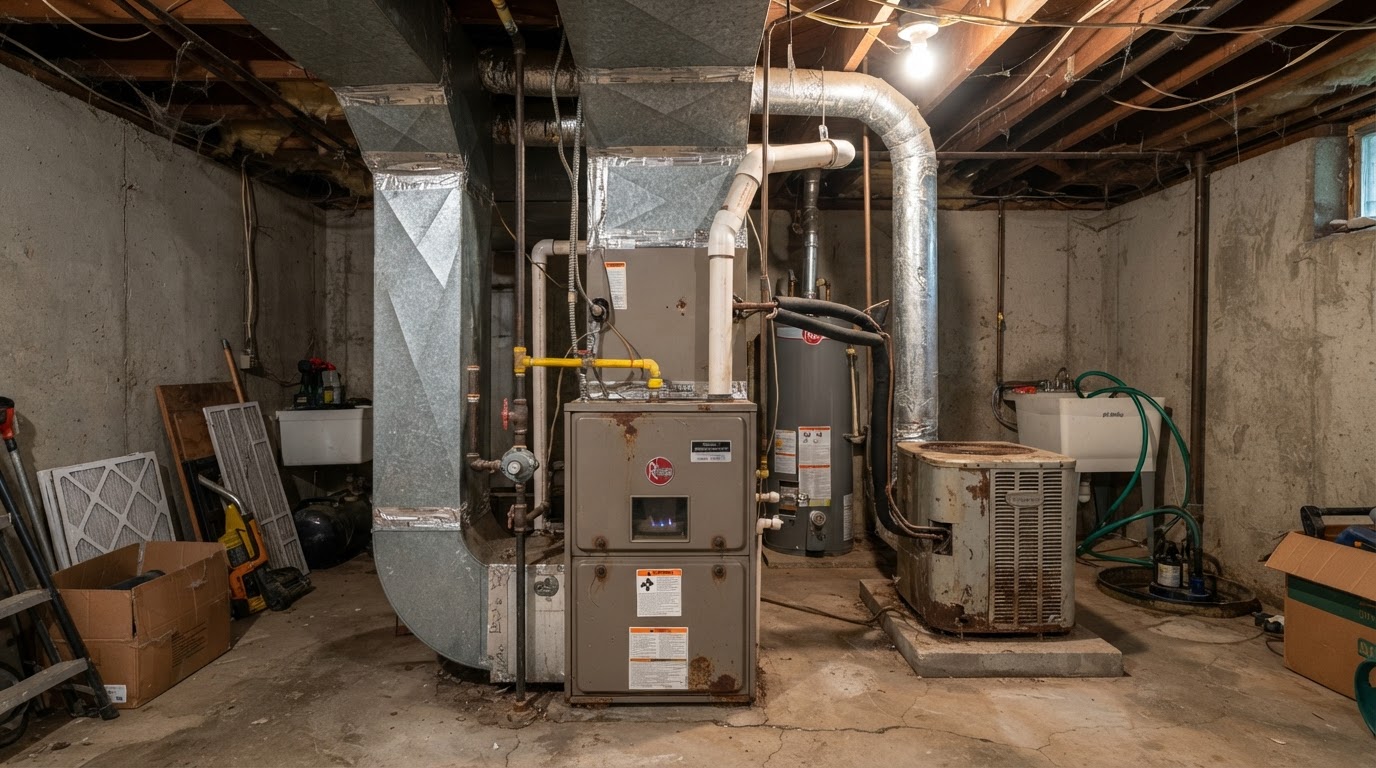
Read the equipment and distribution as one system
Boilers: follow the heat beyond the appliance A boiler transfers heat to water or steam, which travels through piping to emitters such as radiators or baseboards. Accessible leakage, corrosion, unusual operating behavior, and distribution concerns may warrant follow-up. A warm boiler does not establish that every zone, radiator, or concealed radiant loop works as intended. Ask which thermostats and zones were operated and whether occupied rooms responded. If a finished basement contains inaccessible piping, that limitation matters even when the exposed equipment looks orderly. A heating contractor can investigate an unevenly heated area and distinguish control, circulation, distribution, and building-envelope questions. Furnaces: warm air is only part of the observation A furnace heats air that a blower moves through ducts. Visible duct condition, accessible filters, registers, and the response to normal controls provide context. The inspection is not the same as dismantling the furnace or performing a comprehensive combustion and heat-exchanger evaluation. A report calling for service should identify the observed reason where possible. “Service due because records are unavailable” and “further evaluation recommended because of abnormal operation” create different tasks. Ask the contractor to address the specific concern rather than issuing a general receipt that says “tuned up.” Central AC and heat pumps: record the mode tested Central air-conditioning equipment removes heat from indoor air. A heat pump can provide cooling and heating, but the testable mode depends on equipment instructions, conditions, and inspection scope. An inspection during cool weather may leave cooling performance unresolved even if the heating mode responds normally. For a property with several systems, record results individually. “AC operated” is too broad if it applies only to the first-floor unit. An untested guest-house system remains an open item; another working system does not answer that question.
What equipment age does - and does not - tell you
An approximate manufacturing date helps with budgeting and service research. It is not necessarily the installation date, and it is not a replacement deadline. A readable label, installation invoice, and maintenance record answer different questions. ENERGY STAR's replacement guidance identifies air conditioners or heat pumps over 10 years old and furnaces or boilers over 15 years old as reasons to consider professional advice about replacement or performance improvements. These are planning triggers, not promises of failure or universal service-life limits. The same guidance considers repair frequency, comfort, and operating problems. For a buyer, a more useful set of questions is: What condition was observed, and was operation normal during the visit? Which parts have been replaced, and which remain original? Is there a documented recurring problem? Can a contractor service the equipment and obtain appropriate parts? Would replacement require changes to ducts, piping, controls, electrical service, or venting? Does the existing arrangement fit the buyer's intended use of the house? Avoid treating a new appliance as proof of a good installation. Conversely, an older system that responds normally still needs an ownership plan, but age alone does not establish an immediate defect.
Why an inspector may leave a system unoperated
Operating restrictions protect equipment and people. Conditions that make operation inappropriate should be recorded rather than bypassed to produce a reassuring result. New York's home-inspection standards do not require operating cooling equipment below 65°F or where operation may cause damage. Manufacturer instructions and actual conditions also matter; the rule is not a universal permission to run every system above that temperature. Other limitations can include disconnected utilities, inaccessible controls, incomplete installation, an apparent unsafe condition, or an owner-imposed restriction. Read the reason and ask what a qualified provider would need to complete the evaluation. A service record can supply history, but it cannot substitute for every missing observation. Do not ask a seller to defeat a safety control or improvise a start-up. If equipment has been shut down, arrange appropriate preparation through its service provider and confirm whether a return inspection or specialist visit is needed.
Use maintenance records to investigate a pattern
The most useful records describe the equipment, date, work performed, measurements where relevant, and unresolved recommendations. A sticker showing the contractor's phone number is not a maintenance history. ENERGY STAR's maintenance checklist recommends annual professional preseason checkups and identifies tasks such as checking controls, condensate drainage, electrical connections, airflow, and combustion-related components as applicable. A general home inspection does not automatically include that service work. Request recent invoices and ask about repeated service calls. If the seller reports that refrigerant was added several times, ask an HVAC contractor what investigation is appropriate; do not assume another recharge resolves the underlying question. If a thermostat was replaced after comfort complaints, ask whether the complaints stopped and whether other work was recommended. Operating bills can help the buyer understand history, but they reflect occupancy, thermostat settings, weather, and other factors. They are not a standalone efficiency test or a reliable promise of the next owner's costs.
Turn the report into an ownership plan
Sort follow-up by the question that remains open: Illustrative scenario: A house has an older boiler and a newer upstairs heat pump. The boiler responds, but one room remains cool; the heat pump's cooling mode is not tested because of outdoor conditions. The buyer has two separate questions: why the room did not heat and how to evaluate cooling later. Replacing the oldest appliance is not automatically the answer to either question. If the property includes guest houses or several mechanical rooms, the STS luxury inspection service is a useful starting point for discussing coordination. Review sample report formats to understand how findings and limitations are presented, without treating another property's report as evidence about yours.