
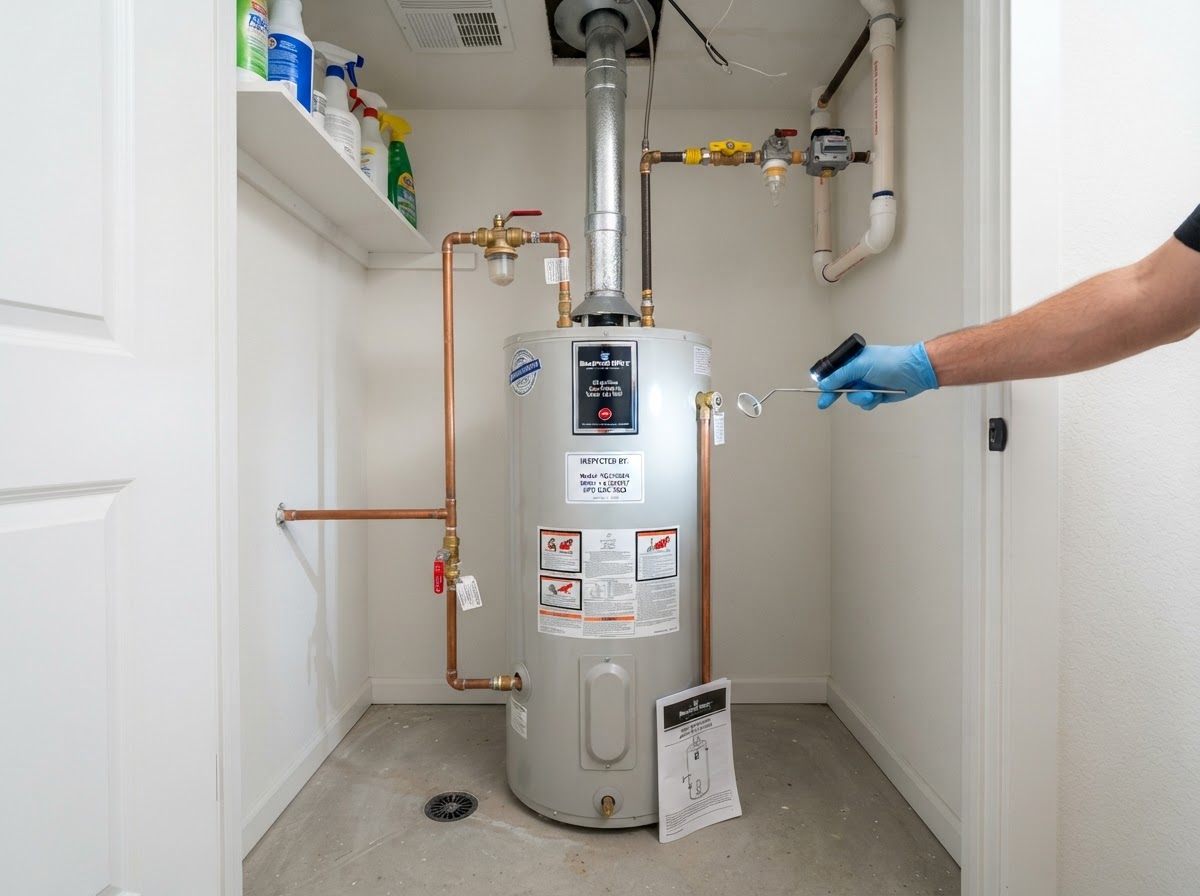
A water heater that produces hot water during an inspection has demonstrated a limited function, not its ability to meet every household demand. Buyers should consider the equipment type, accessible condition, installation context, service history and any operating restrictions. Leakage, questionable venting or a missing installation record can require follow-up even when a faucet becomes warm. Age is useful background, but it is not a mandatory replacement deadline.
Identify how the house makes domestic hot water
Domestic hot water serves sinks, showers and other household uses. It may come from a storage water heater, an on-demand tankless unit or an indirect tank heated through another appliance. The name of the equipment matters because the inspection and performance questions differ. A storage heater keeps a quantity of heated water available. Its useful delivery depends on factors including stored volume, heating input, settings and recovery as hot water is drawn. A tankless unit heats water as it passes through, with delivery depending on the model and operating conditions. An indirect tank typically receives heat through a heat exchanger connected to a boiler or other heat source. Manufacturer information helps explain those distinctions. Rheem's tankless product information describes model-specific flow performance, while Weil-McLain's indirect-tank information illustrates equipment whose output depends on its connected heat source. Neither product family establishes the performance of an unidentified unit in a house for sale. Record the make, model and accessible identification data. If the label cannot be read, say so. Guessing age or capacity from the jacket color is not useful due diligence.
Condition and installation answer different questions
Visible leakage, corrosion, damage or evidence of past discharge can justify a closer evaluation. The inspector should locate the observation and distinguish active moisture from staining or deposits that were dry at the time. A dry floor does not establish that the heater has never leaked. Installation context includes accessible connections, supports, combustion or electrical supply arrangements, venting where applicable and the discharge arrangement for protective devices. The correct configuration depends on the specific equipment and applicable requirements. A general article cannot certify an installation from a photograph or prescribe one arrangement for all heaters. Under the NYS home-inspection standards, the inspection addresses accessible water-heating equipment within a visual, noninvasive scope. It is not a full internal examination, a service appointment or a prediction of remaining life. A qualified plumber or other appropriately licensed professional may need to resolve a particular installation concern.
Combustion equipment needs a venting question
Fuel-burning water heaters have installation requirements that differ from electric units. Ask the inspector what portions of the venting and combustion-air arrangement were accessible, whether concerns were observed, and what further evaluation is recommended. An apparently operating burner does not independently establish satisfactory venting under all conditions. A replaced heater may have different instructions from the previous one. If the seller reports a recent installation, obtain the model-specific manual, contractor information and completion records. Ask whether the work addressed the entire relevant installation or only exchanged the tank. Do not block an opening, disconnect a vent or alter equipment to experiment with performance. Unfamiliar combustion equipment should be evaluated and operated by an appropriate professional under suitable conditions. If the inspector identifies a condition requiring restricted operation, resolve that recommendation before normal use.
Temperature is both a comfort question and a safety question
Very hot water can cause scald injuries. The Consumer Product Safety Commission's tap-water guidance explains that lower delivery temperatures can reduce scald risk and discusses 120°F as a risk-reduction setting. That guidance does not mean a labeled dial position guarantees the temperature at every fixture or eliminates all risk. Ask a qualified plumber about the property's actual arrangement, including any mixing or temperature-control devices and the needs of the household. Children and people who cannot quickly move away from hot water may need particular attention to delivery-temperature protection. Storage settings, delivered temperatures and manufacturer instructions should be considered together. A buyer should not change unfamiliar equipment settings during a showing. Also, do not assume that a general inspection measured and verified every fixture's temperature. Ask what was included and what further measurement or adjustment is appropriate.
A brief functional observation does not size the system
Hot water at one faucet establishes a narrow observation at a particular moment. It does not establish the number of simultaneous showers the system can support, the recovery after a long draw or the delivery under different incoming-water conditions. For tankless equipment, compare household demand with the manufacturer's performance information for the relevant temperature rise, rather than relying on an unqualified headline gallons-per-minute number. For storage and indirect systems, ask about usable delivery and recovery in the actual installation. A plumber can evaluate these questions with the equipment data and intended use. This is especially useful when a Long Island home has been expanded or bathrooms added. Request records for the actual configuration rather than assuming the original hot-water arrangement was evaluated for every later fixture. Municipal approvals and physical performance are separate questions; neither should be inferred from the other.
Questions for a licensed plumber
Bring the inspection finding and equipment information to the conversation. A specific question produces a more useful proposal than “check the water heater.” A replacement proposal should identify the full scope. Comparing only tank prices can obscure differences in venting, controls, piping or other necessary installation work. Those are project questions for the professional evaluating the property, not a reason to assume every older unit requires replacement.
Use age as context, not a verdict
If the identification label or installation record supports a date, include it in the property file. If the age is uncertain, distinguish a seller's recollection from verified documentation. Serial-number interpretation should follow information applicable to the manufacturer and model. Condition, service history, water conditions, equipment type and installation all affect useful service. This article does not assign a universal life expectancy because that would suggest precision the individual property evidence may not support. A functioning older unit can still warrant planning, and a newer unit can still have an installation defect. Ask what evidence supports immediate action, what remains uncertain and what future planning is sensible. The answer should connect to the actual finding rather than a calendar age alone.
Prepare for a useful inspection
Clear authorized access to the heater and its identification label, controls and surrounding area. Ask the seller to provide manuals and service records. If utilities are off or equipment has been winterized, have the owner coordinate any restoration with qualified professionals before the appointment; do not activate it yourself. STS's buyer-inspection scope includes accessible plumbing and water-heating observations. Review available services and tell the inspector about shutdowns or known hot-water concerns. Ask about how findings are documented. The resulting report should separate operation observed from components that could not be assessed. Illustrative scenario: a tankless unit supplies a kitchen faucet normally, but the buyer expects three showers to run together. The inspection observation is useful without resolving that demand question. A model-specific sizing discussion with a plumber is the appropriate additional step.