
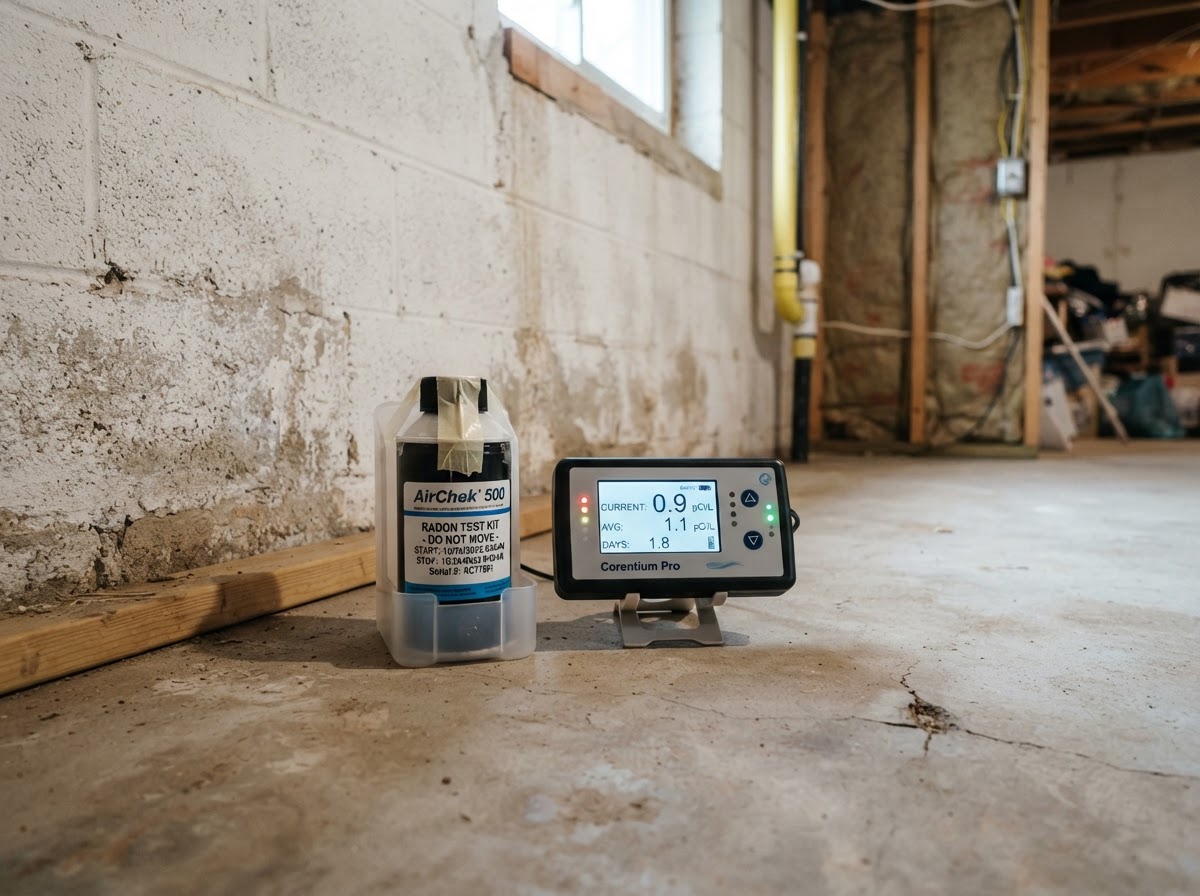
A home's radon level must be measured at that property; a regional map or a neighbor's result cannot establish it. For a purchase, plan the test around the correct location, operating conditions, test duration and transaction schedule. Then interpret the result using the relevant protocol and decide whether follow-up testing or mitigation is needed. A number without its test conditions is an incomplete piece of evidence.
Why the address matters more than the regional label
Radon is a naturally occurring radioactive gas that can enter buildings from the ground. It cannot be identified by sight or smell. The EPA's Home Buyer's and Seller's Guide to Radon explains why testing is relevant to a home purchase and why the result belongs to the building tested. Long Island's location does not make an individual property exempt from the question. Foundation construction, pathways into the building, operating conditions and other property-specific factors can affect measured concentrations. A county map is useful background for public-health planning; it is not a test report for the house you intend to buy. A finished lower level can make the test-location question especially important. Tell the testing professional how the lowest level is currently used and how you expect to use it. The correct test plan should follow the applicable protocol rather than simply putting the device in the most convenient room.
Decide what question the test must answer
A short-term test is often used when a transaction has a limited schedule. A longer test can provide different information about variation over time. The CDC's testing guidance distinguishes short-term tests lasting 2–90 days from long-term tests lasting more than 90 days and explains that longer measurements better represent the year-round average. These categories do not mean that every device can be left in place for any duration. Use a device and laboratory or measurement provider appropriate to the selected method. The professional should explain placement, collection, reporting and whether a follow-up measurement will be necessary. Ask the attorney or agent about the time available under the transaction documents, then tell the tester the actual deadline. Do not shorten a test below its protocol to fit a closing date. If adequate testing cannot be completed, the unresolved information should be discussed openly with the professionals handling the purchase.
Conditions are part of the result
Closed-building conditions generally restrict opening windows and exterior doors beyond normal entry and exit. They do not mean sealing the house with tape or altering unfamiliar mechanical equipment. The tester should give occupants written instructions suited to the method and identify which ordinary systems may operate. EPA's buyer-and-seller guidance calls for closed-house conditions beginning at least 12 hours before a 2–3 day short-term test and continuing during it. New York's Department of Health radon guidance advises closed-house conditions for 24 hours before and during its short-term testing guidance. These are attributable instructions, not interchangeable guesses about what “closed” means. Ask your testing professional to state and apply the protocol governing the test. Occupants, cleaners, contractors and real-estate professionals all need the same instructions. A window opened for painting or a door left open during a move can affect test conditions. Record interruptions and tell the tester; do not hide them because the result appears favorable. Weather and building operation also matter. EPA advises considering weather when scheduling short tests and avoiding specified unusual conditions for tests lasting less than a week. Let the tester decide whether the planned conditions satisfy the protocol instead of assuming that any completed device exposure produces an equally useful result.
A test-planning worksheet
Complete this with the measurement provider before the device is placed. It helps separate a scheduling problem from a result-interpretation problem. For an occupied home, ask the seller's representative to coordinate the instructions. For a vacant home, confirm that the building can be placed and kept in the required condition. A locked house is not automatically a correctly prepared house.
Understand the action level precisely
Radon results in the United States are commonly reported in picocuries per liter, written pCi/L. EPA recommends fixing a home when the radon level is 4 pCi/L or higherand considering reduction when it is between 2 and 4 pCi/L . EPA also emphasizes that a level below 4 is not a declaration of zero risk. Those recommendations guide environmental risk reduction; they are not a diagnosis of anyone's health and do not, by themselves, determine a buyer's contractual rights. Questions about symptoms or personal medical risk belong with a qualified clinician. Questions about what a seller must do under a contract belong with the buyer's attorney. The next testing step depends on the initial method, result and circumstances. Ask the tester to explain the applicable follow-up procedure from the EPA guide or relevant protocol. Do not independently average unrelated reports from different years or different locations to produce a more appealing number.
Read a seller's report as a record, not a permanent certificate
Request the complete report rather than a photograph of the final value. Check the address, dates, test location, method and any reported conditions. Ask what has changed since the measurement: lower-level use, additions, substantial renovations, ventilation arrangements or a mitigation system may make an older result less useful for the present question. The EPA's retesting guidance identifies circumstances in which a new test is appropriate, including relevant changes to the building or its use. A previous low result is useful history, but it is not a lifetime guarantee. Illustrative scenario: a seller has a satisfactory test from an upstairs room several years earlier. The buyer plans to use a newly finished basement as a daily office. The report may be genuine and still fail to answer the buyer's current question. A qualified tester should plan the new measurement around the applicable location and conditions.
Mitigation is a separate service and verification step
Radon mitigation means work intended to reduce indoor concentrations. It is different from measuring the level. A mitigation professional evaluates the building and proposes a suitable approach; a home inspection does not design that system. If a system already exists, request the installation records, service information and post-installation test results. Ask the relevant professionals about visible system condition, maintenance, operating indicators and an appropriate current test. An operating fan or a favorable-looking gauge does not independently measure the radon concentration in occupied space. When new mitigation is installed, plan verification testing under the recommended procedure. Keep the resulting reports with the property records. The practical objective is demonstrated performance under a valid test, not simply proof that equipment was purchased.
Coordinate radon with the rest of the purchase
A radon test and a general buyer inspection answer different questions. Arrange each explicitly and avoid assuming that one is automatically included in the other. Confirm the available services, testing provider and timing through STS's service information and direct discussion before booking. Keep the report with the other due-diligence documents, but interpret it on its own terms. Moisture, mold and radon are different subjects with different methods. A favorable observation about one cannot establish the condition of another.