
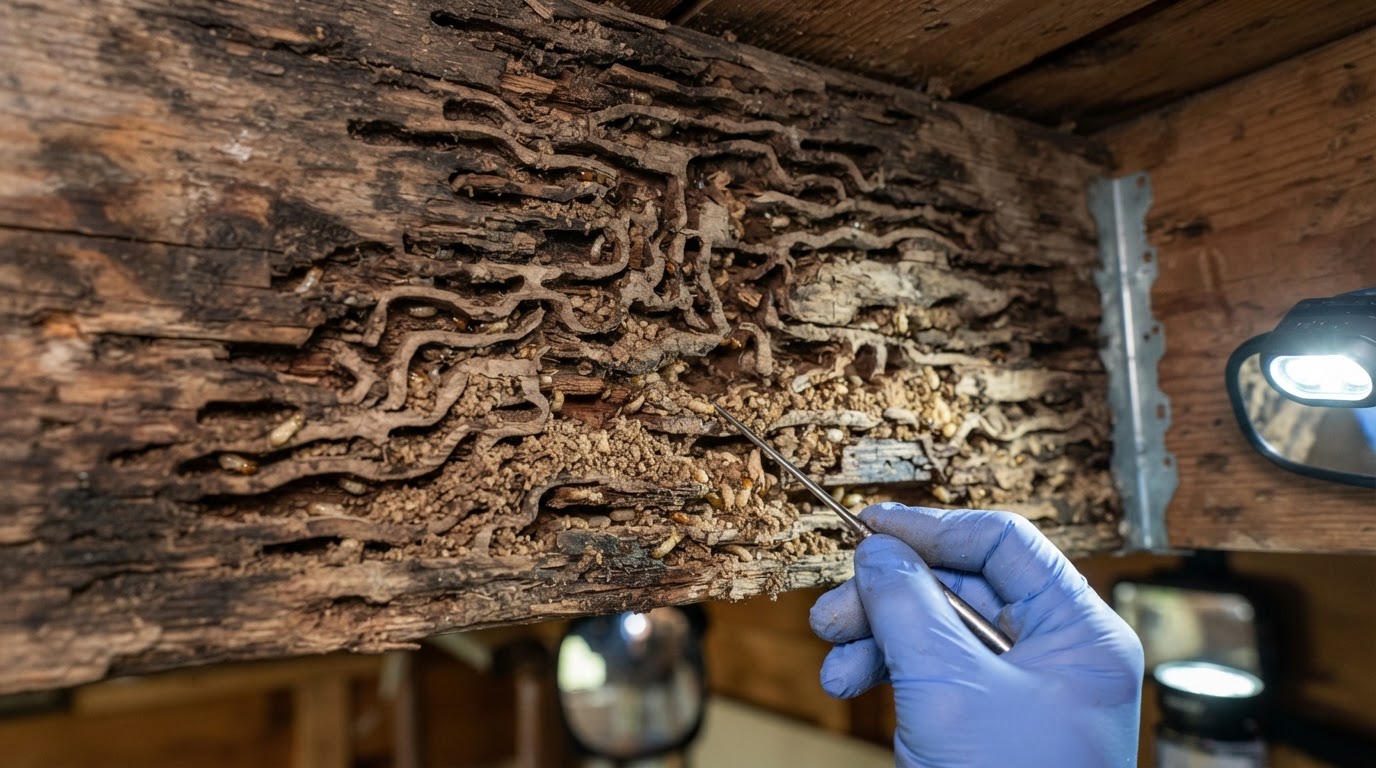
Historic damage is still useful information
Old damage can remain after a treatment. The buyer needs to understand what was affected, what work was performed, and whether the present condition needs further evaluation. “Previously treated” should lead to a request for dates, contractor records, treatment locations, product or method information where available, and any ongoing service agreement. It should not be translated into “currently pest-free.” Ask whether the agreement is transferable and what it actually covers; the answer belongs in the provider’s documents. Similarly, the absence of fresh-looking evidence in accessible areas is a limited observation. It does not establish when all concealed damage occurred or whether every part of the building has been evaluated. If structural wood is visibly deteriorated, ask the appropriate qualified professional to assess the extent and correction. Pest treatment and carpentry may both be necessary, but they are separate scopes of work.
Access controls the confidence of the result
Finished basement walls, insulation, stored belongings, low crawl-space clearance, and inaccessible exterior areas can limit the inspection. Even well-maintained homes contain concealed wood. Ask how much of the sill, joists, foundation perimeter, and other relevant accessible areas could be observed. A report should identify restrictions that matter. Where a particular concern is concealed, discuss whether owner-authorized access or specialist investigation would be useful before your decision deadline. The STS services overview can help frame the scope discussion. Avoid assuming that a visual inspection includes destructive investigation, removal of finishes, or opening every wall cavity.
What is an NPMA-33 report?
NPMA-33 is a wood-destroying insect inspection report used in real estate transactions. The National Pest Management Association’s completion guidance describes reporting visible evidence and visible damage and emphasizes that state requirements still apply. A lender may request that form or other documentation appropriate to the transaction. The form’s purpose does not expand the physical inspection beyond its stated scope and limitations. Ask which structures are included and whether detached buildings need separate identification. Do not wait until closing week to discover that the lender requires a document the original inspection did not provide. Send the written lender request to the inspector, including any timing, signature, qualification, or follow-up requirements. The lender should confirm what it will accept.
A specific Long Island example: VA documentation
The U.S. Department of Veterans Affairs’ local requirements page lists Nassau and Suffolk among New York counties requiring wood-destroying insect information. The page reviewed for this article was last updated July 11, 2025. VA local requirements. That is a VA program requirement, not a statement that every Long Island sale uses identical forms or procedures. Loan type, property circumstances, and the lender’s instructions matter. Confirm the actual requirement for your loan rather than relying on an agent’s recollection of another transaction. Your attorney and lender can explain how documentation, treatment, repairs, or reinspection affect the transaction. The inspector’s role is to report the findings and deliver the agreed documentation within the applicable scope.
A buyer’s evidence checklist
This checklist helps prevent a common misunderstanding: collecting a treatment invoice without resolving the damage question, or collecting a clean-looking report without understanding an important access limitation.
Illustrative scenario: treatment record and damaged sill
Suppose the seller provides a prior treatment invoice. The inspection documents visible damage at an accessible sill area, but stored belongings block the adjoining section. No live insects are observed during that visit. Those facts support several separate next steps: review the treatment history with the pest professional, arrange suitable access to the blocked section, and obtain an assessment of the damaged wood. They do not support saying the treatment failed or that the whole area is now satisfactory. This is a hypothetical example, not an STS case study.
What to do when a concern is reported
Ask the inspector to clarify the evidence and recommendation. Then provide the relevant report section to the pest professional or contractor who will evaluate the issue. Request a written scope that distinguishes treatment, monitoring, access work, and structural repairs. If a lender requires follow-up, coordinate that documentation directly with the lender and the appropriate provider. Do not assume a general invoice satisfies every requirement. Keep the original report and later records together so the sequence is understandable. The STS sample-report page provides a reporting preview. Ask separately about the form and deliverable needed for your transaction; a general sample report is not a promise that a particular lender document is included.